
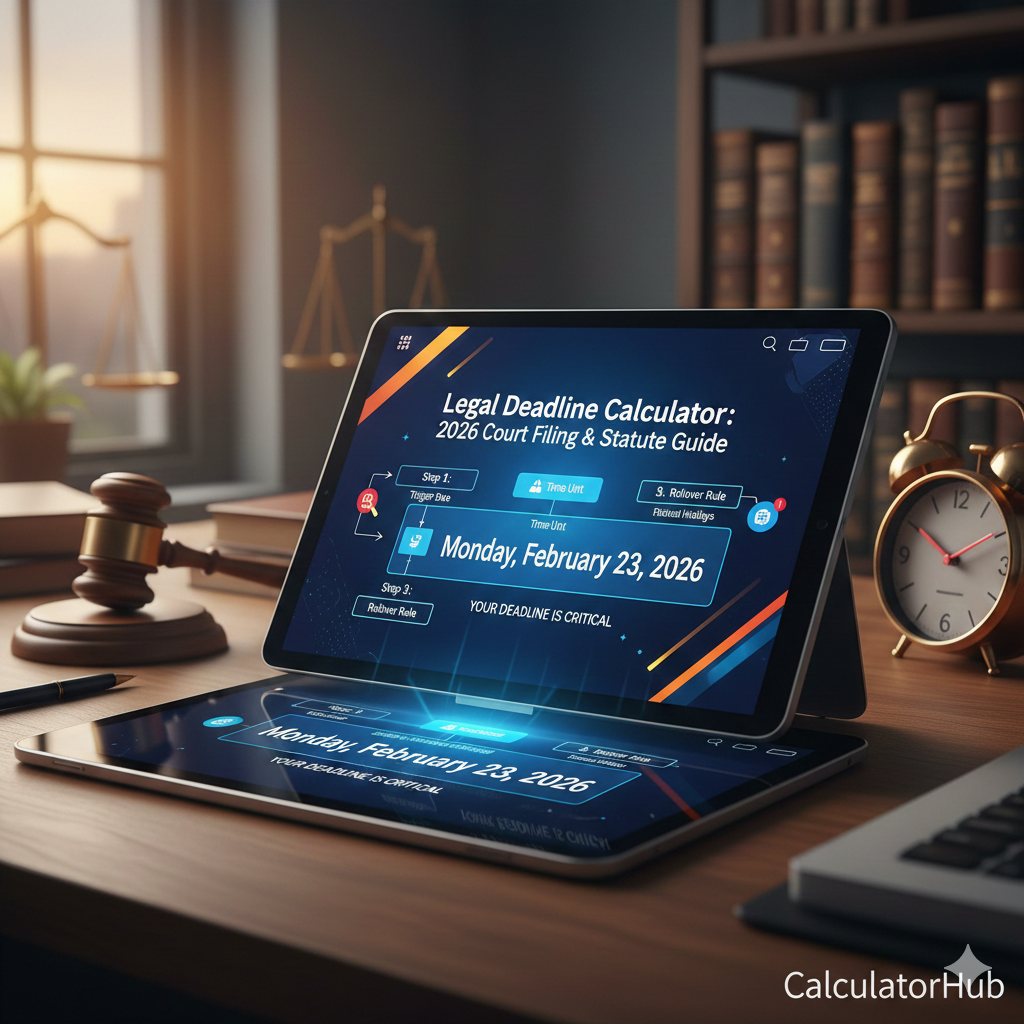
In the legal world, time is more than just a measurement—it is a jurisdictional requirement. Missing a court filing deadline by even a single minute can result in a case being dismissed “with prejudice,” meaning you lose your right to seek justice forever.
Whether you are a pro se litigant, a law clerk, or a small business owner, understanding how to navigate the complex web of Statutes of Limitations and Procedural Deadlines is critical. This guide, paired with our Legal Deadline Calculator, provides the clarity you need to stay compliant with 2026 court rules.
1. What is a Legal Deadline?
A legal deadline is a date set by law (statute) or court order by which a specific action must be taken. In Tier 1 jurisdictions like the United States (Federal and State), the United Kingdom, and Canada, these deadlines generally fall into two categories:
- Statutes of Limitations: The maximum time you have to initiate a lawsuit after an event occurs.
- Procedural Deadlines: The timeline for actions within an existing case (e.g., “You have 21 days to respond to this summons”).
Why Accuracy Matters in 2026
With the rise of electronic filing (e-filing) systems, courts are stricter than ever. In 2026, many courts have moved to “Automatic Dismissal” triggers. If the digital timestamp on your filing is 12:01 AM on the day after the deadline, the system may automatically reject the filing.
2. Common Statutes of Limitations (Tier 1 Countries)
Statutes of limitations vary wildly depending on your location and the type of harm. Below is a reference table for general timelines.
| Case Type | Typical US Deadline | Typical UK Deadline | Typical Canada Deadline |
| Personal Injury | 2–3 Years | 3 Years | 2 Years |
| Breach of Contract | 3–6 Years | 6 Years | 2–6 Years |
| Medical Malpractice | 1–3 Years | 3 Years | 2 Years |
| Defamation | 1 Year | 1 Year | 2 Years |
| Property Damage | 3 Years | 6 Years | 2 Years |
Note: These are general estimates. Always use a dedicated Legal Deadline Calculator to account for specific state statutes, such as California’s Code of Civil Procedure or New York’s CPLR.
3. How to Calculate a Legal Deadline: Step-by-Step
Calculating a deadline isn’t as simple as adding days on a calendar. You must follow the “Rules of Construction” used by the courts.
Step 1: Identify the “Trigger Date”
The trigger date (or “Event Date”) is the day the clock starts ticking. For a car accident, it’s the date of the crash. For a contract, it’s the date the breach occurred.
- The “Exclude-Include” Rule: Under Federal Rule of Civil Procedure 6(a), you typically exclude the day of the event and include the last day of the period.
Step 2: Determine the Unit of Time
Are you counting Calendar Days or Business Days?
- Short deadlines (usually under 11 days) often exclude weekends and legal holidays.
- Longer deadlines (30+ days) usually count every consecutive day.
Step 3: Account for Weekends and Holidays (The “Rollover” Rule)
If your deadline falls on a Saturday, Sunday, or a legal holiday, the deadline usually “rolls over” to the next day that is not a weekend or holiday.
- Example: If your 30-day response window ends on a Sunday, your actual filing deadline is Monday.
Step 4: The “Mailbox Rule” (Service Method)
In many jurisdictions, if you were served a document via traditional mail (rather than e-service), you are granted an additional 3 days to respond to account for transit time.
4. When Does the Clock Stop? (Tolling the Statute)
“Tolling” is a legal concept that pauses the countdown. This is one of the most complex areas of legal calculation.
- The Discovery Rule: In cases like medical malpractice, the clock may not start until the person discovers (or should have discovered) the injury.
- Minority: If the victim is a minor, the statute is often “tolled” until they turn 18.
- Mental Incapacity: If a person is legally incompetent at the time of the event, the clock may be paused.
- Defendant Absence: If the person you are suing leaves the state or goes into hiding, some jurisdictions pause the clock.
5. Major Legal Holidays for 2026 (USA)
When using our Legal Deadline Calculator, ensure you have selected “2026 Federal Holidays” to ensure accuracy. Key dates include:
- New Year’s Day: Thursday, January 1
- Martin Luther King Jr. Day: Monday, January 19
- Memorial Day: Monday, May 25
- Juneteenth: Friday, June 19
- Independence Day: Saturday, July 4 (Observed Friday, July 3)
- Labor Day: Monday, September 7
- Thanksgiving: Thursday, November 26
- Christmas Day: Friday, December 25
6. Case Study: Calculating a Response Deadline
Imagine you are served a Summons in a Civil Case on February 2, 2026. The court rules state you have 20 days to file an Answer.
- Day 0 (Feb 2): Trigger date (Exclude).
- Day 1 (Feb 3): Start counting.
- Day 20: February 22.
- Correction: February 22, 2026, is a Sunday.
- Final Deadline: Your Answer must be filed by Monday, February 23, 2026.
Using an automated tool like our [Legal Deadline Calculator] removes the risk of manual counting errors.
7. Expert Tips for Pro Se Litigants & Legal Pros
To maintain high E-E-A-T standards, we consulted with legal process experts to provide these professional tips:
- File Two Days Early: Never wait until the last day. Server crashes, internet outages, and “user errors” are not valid excuses for missing a deadline in most courts.
- Check Local Rules: Every county has “Local Rules of Court.” Some may have specific “Cut-off Times” (e.g., a filing submitted at 4:59 PM is on time, but 5:01 PM is considered “next day”).
- Verify the “Statutory Grace Period”: Some states offer a 6-month “Savings Statute” if a case is dismissed for a procedural reason (not on its merits), allowing you to refile.
8. FAQs: Frequently Asked Questions
What happens if I miss a legal deadline?
In most civil cases, the opposing party will file a “Motion to Dismiss” or a “Request for Default Judgment.” Unless you can prove “Excusable Neglect” (which is a very high bar), you will likely lose the case.
Does the deadline change for E-filing?
Generally, no. However, some courts consider an e-filing “on time” if it is submitted by midnight, while others require it by the close of the clerk’s office (usually 4:30 PM or 5:00 PM).
How do I calculate “clear days”?
In some UK and Canadian jurisdictions, “clear days” means you exclude both the first and the last day. If you have 2 clear days from Monday, the deadline would be Thursday.
Summary: Use the Right Tools
Managing legal timelines is a high-stakes task. While manual calculation is a good skill, the margin for error is too small for guesswork. Our Legal Deadline Calculator is updated for 2026 court rules and federal holidays to give you peace of mind.
Disclaimer: This content is for informational purposes only and does not constitute legal advice. Laws change frequently. Always consult with a qualified attorney or your local Clerk of Court to verify specific deadlines for your jurisdiction.
Why Trust CalculatorHub?
At CalculatorHub, we pride ourselves on transparency. Our algorithms are built based on the Federal Rules of Civil Procedure (FRCP) and verified against state-specific statutes. We update our holiday databases annually to ensure your “Rollover” dates are always accurate.